The Father's Sabbath Lamp Incident
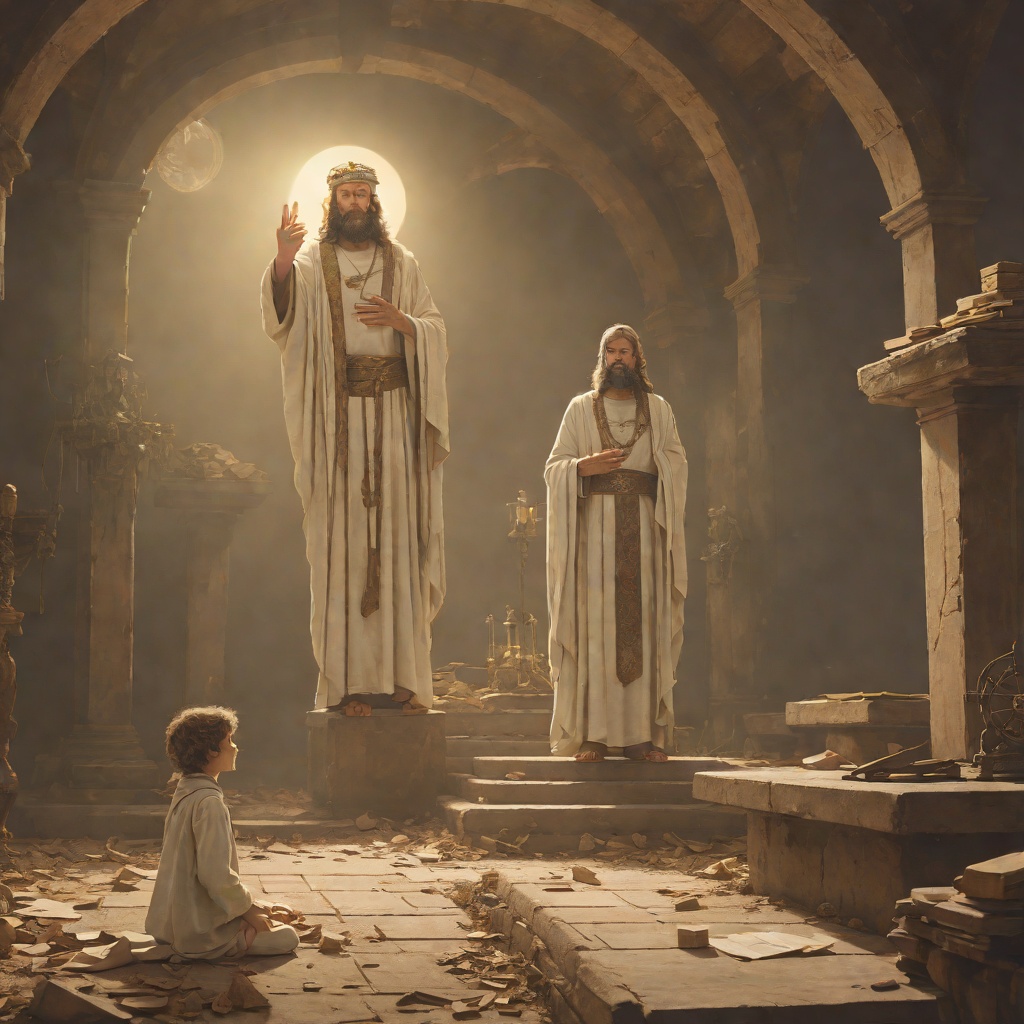
The Captain and Ann BarbaraOne Friday night in Polotzk, the young Mary Antin lay wakeful in her little bed, staring from the darkness into the lighted room adjoining hers. The Sabbath candles had sputtered and gone out one by one, but the lamp hanging from the ceiling still burned high, and would continue to burn until Natasha, the Gentile chorewoman, came in the morning to put it out, remove the candlesticks from the table, unseal the oven, and perform the dozen little tasks which no Jew could perform on the Sabbath. The simple prohibition to labor on the Sabbath day had been construed by zealous commentators to mean much more: one must not even touch any instrument of labor or commerce, as an axe or a coin, nor light a fire, nor touch anything that contained a fire or had contained fire, were it only a cold candlestick or a burned match. The lamp at which Mary was staring must therefore burn till the Gentile woman came to put it out. The light did not annoy the child in the least; she was not thinking about it. But apparently it troubled somebody else.
The Secret Act
Mary saw her father come from his room, which also adjoined the living-room. What was he going to do? What was this he was doing? Could she believe her eyes? Her father touched the lighted lamp—yes, he shook it, as if to see how much oil there was left. Mary was petrified in her place, unable to move or make a sound. It seemed to her he must feel her eyes bulging at him out of the dark, but he did not know that she was looking; he thought everybody was asleep. He turned down the light a very little, and waited. She did not take her eyes from him. He lowered the flame a little more, and waited again. By the slightest degrees he turned the light down. Mary understood: in case any one were awake, it would appear as if the lamp was going out of itself. She was the only one who lay so as to be able to see him, and she had gone to bed so early that he could not suppose she was awake. The light annoyed him, he wanted to put it out, but he would not risk having it known.
The Weight of the Sin
Mary heard her father find his bed in the dark before she dared to draw a full breath. The thing he had done was a monstrous sin. If his mother had seen him do it, it would have broken her heart—his mother who fasted half the days of the year, when he was a boy, to save his teacher's fee; his mother who walked almost barefoot in the cruel snow to carry him on her shoulders to school when she had no shoes for him; his mother who made it her pious pride to raise up a learned son, that most precious offering in the eyes of the great God, from the hand of a poor struggling woman. If Mary's own mother had seen it, it would have grieved her no less—the mother who was given to him, with her youth and good name and her dowry, in exchange for his learning and piety; the mother who was taken from her play to bear him children and feed them and keep them, while he sat on the benches of the scholars and repaid her labors with the fame of his learning. Mary did not put it to herself just so, but she understood that learning and piety were the things most valued in her family, that her father was a scholar, and that piety, of course, was the fruit of sacred learning. And yet her father had deliberately violated the Sabbath.
The Child's Reckoning
His act was not to be compared with Mary's own earlier carrying of the handkerchief on the Sabbath, a secret experiment she had conducted to test whether it was sinful to bear a burden on the holy day. The two sins were of the same kind, but the sinners and their motives were different. She was a child, a girl at that, not yet of the age of moral responsibility. He was a man full grown, passing for one of God's elect, and accepting the reverence of the world as due tribute to his scholarly merits. Mary had by no means satisfied herself, by her secret experiment, that it was not sinful to carry a burden on the Sabbath day. If God did not punish her on the spot, perhaps it was because of her youth or perhaps it was because of her motive. According to her elders, her father, by turning out the lamp, committed the sin of Sabbath-breaking. What did her father intend? She could not suppose that his purpose was similar to hers. Surely he, who had lived so long and studied so deeply, had by this time resolved all his doubts. Surely God had instructed him. She could not believe that he did wrong knowingly, so she came to the conclusion that he did not hold it a sin to touch a lighted lamp on Sabbath. Then why was he so secret in his action? That, too, became clear to her. She herself had instinctively adopted secret methods in all her little investigations, and had kept the results to herself. The way in which her questions were received had taught her much. She had a dim, inarticulate understanding of the horror and indignation which her father would excite if he, supposedly a man of piety, should publish the heretical opinion that it was not wrong to handle fire on the Sabbath.
The Lesson of Concealment
To see what remorse her mother suffered, or her father's mother, if by some accident she failed in any point of religious observance, was to know that she could never be brought to doubt the sacred importance of the thousand minutiæ of ancient Jewish practice. That which had been taught them as the truth by their fathers and mothers was the whole truth to her good friends and neighbors—that and nothing else. If there were any people in Polotzk who had strange private opinions, such as Mary concluded her father must hold, it was possible that he had a secret acquaintance with them. But it would never do, it was plain to her, to make public confession of his convictions. Such an act would not only break the hearts of his family, but it would also take the bread from the mouths of his children, and ruin them forever. Her sister and her brother and she would come to be called the children of Israel the Apostate, just as Gutke, her playmate, was called the granddaughter of Yankel the Informer. The most innocent of them would be cursed and shunned for the sin of their father.
The Birth of the Dual Conscience
The incident planted in Mary the recognition that religious observance in the Pale was a public performance as much as a private devotion, and that the cost of exposure was social annihilation. It also forged a secret kinship between father and daughter: both were doubters, both concealed their heresy, and both understood instinctively that the community's piety could not bear the weight of honest inquiry. This early lesson in concealment would shadow Mary's later American life, where she would learn to speak her doubts openly in a schoolyard declaration of freethought, and where the family's Old-World habits of secrecy would gradually give way to the public freedoms of the new country. The lamp that her father turned down by the slightest degrees became, in retrospect, the first flame of a private skepticism that Mary herself would carry into the light of America, where the dual conscience of the immigrant—the inward doubt and the outward conformity—could at last be resolved.